ARTICLE
The Golden Thread: What the Building Safety Act Actually Requires
The golden thread is a statutory duty, not an information-management nice-to-have. Here is what the Building Safety Act requires, who holds the duty at each stage, and what changes the day a building is occupied.

Why the Act created a golden thread duty
The golden thread of information is a duty created by the Building Safety Act 2022, and it exists because of a specific, well-documented failure. In the years before the Act, safety-critical information about a building — what was designed, what was actually built, what changed along the way — routinely became fragmented or lost as a project moved from design through construction and into occupation. The independent review commissioned in the wake of the Grenfell Tower fire found that this fragmentation was not incidental; it was close to the default outcome of how the industry kept records, spread across email threads, superseded drawing sets and whichever consultant happened to still have the file.
The Act's response was to turn record-keeping from a matter of good practice into a legal duty for a defined category of buildings: a continuous, accurate, digital record that has to exist from design through to occupation and beyond, and that has to be handed cleanly from whoever holds it at one stage to whoever holds it at the next.
Which buildings the duty applies to
The golden thread duty attaches to "higher-risk buildings," a defined category rather than a general standard applied to every construction project. In practice, that mostly means residential buildings at least 18 metres in height or with at least seven storeys, containing two or more residential units. Some other occupied building types can fall into scope during design and construction specifically, which is why it is worth checking a project's status early rather than assuming a building is out of scope because it is not a typical residential tower. The threshold is not an arbitrary line: it targets the category of building where a fire or structural failure has the highest potential consequence and the slowest, most difficult evacuation, which is also why the Act treats these buildings as a distinct legal category rather than folding the duty into general building regulations.
The Building Safety Regulator oversees this regime. It is the body that reviews the golden thread record at the points in a project where the Act requires it to be checked, and it is the body a building's accountable person answers to once the building is occupied.
The three gateways, and where the golden thread sits at each
Higher-risk building work moves through three gateway points, and the golden thread duty is stitched through all of them rather than arriving as a single deliverable at the end.
- Gateway One, at planning. A fire safety statement has to accompany the planning application, establishing the record before design work is even instructed. Safety is considered while the building's form is still open to change, rather than assessed against a design that has already been fixed.
- Gateway Two, before construction starts. This is a hard stop: an application for building control approval goes to the Building Safety Regulator, and higher-risk building work cannot begin until it is approved. The golden thread has to be substantial enough by this point to support that approval. Reviewers at this stage are checking whether the design information is sufficient and internally consistent, not simply whether a folder of documents has been submitted.
- Gateway Three, at completion. Before the building can be occupied, an application for a completion certificate goes to the Regulator, and the golden thread compiled through design and construction has to be handed over intact to whoever will hold it next. The Regulator's check here is whether what was actually built, and how it is intended to be maintained, still matches what was approved earlier — not just that a record exists.
Missing or incomplete information at any gateway does not just create paperwork — it can stop the project from proceeding to the next stage.
Who is accountable, and when the duty changes hands
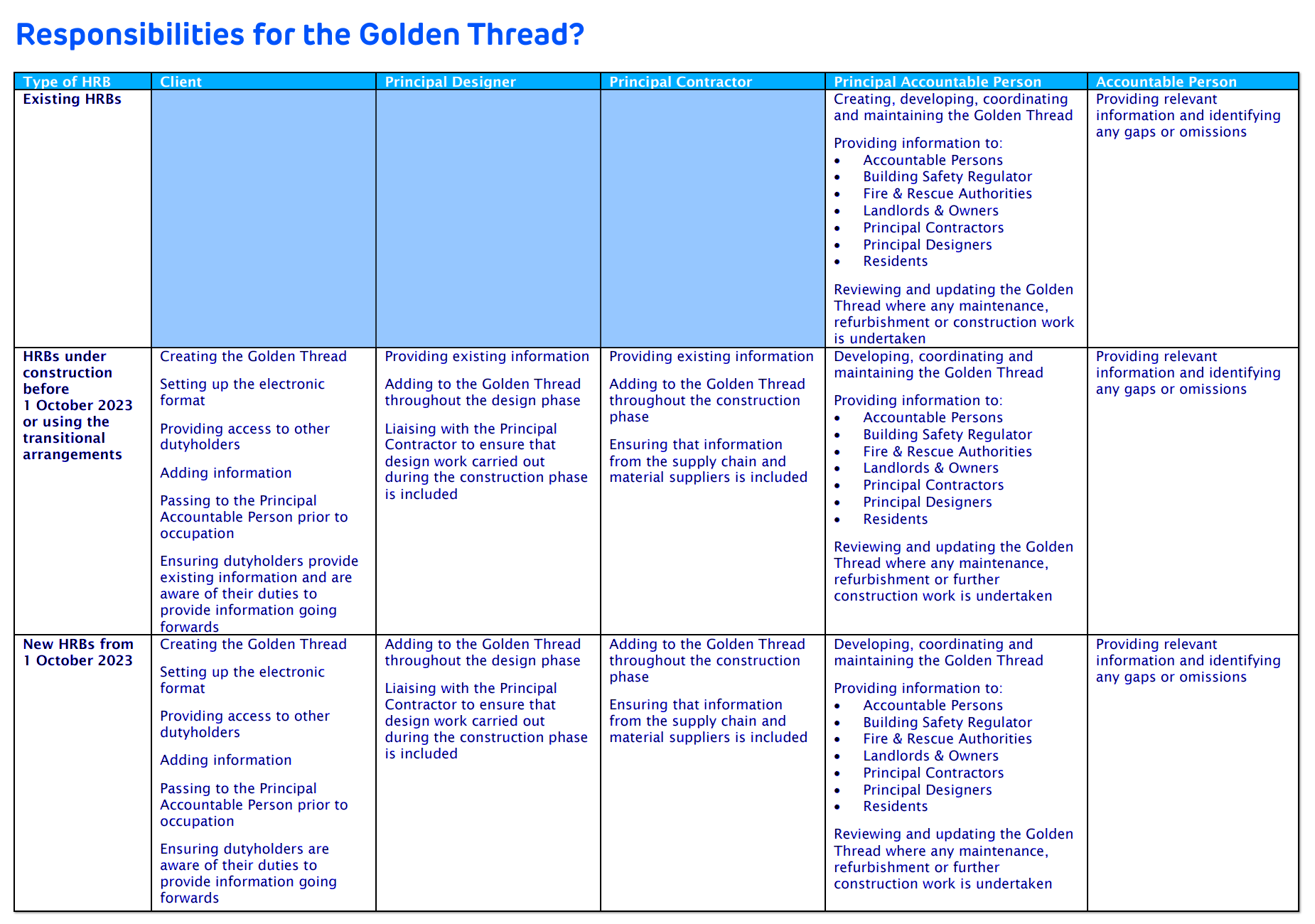
During design and construction, the duty sits with the client, the principal designer and the principal contractor, each responsible for the accuracy of the information their part of the project contributes to the record. None of them get to treat the golden thread as someone else's problem: the Act's structure assumes the record is only as good as its weakest contributor.
Once the building is occupied, responsibility passes to the accountable person — the organisation or individual responsible for the building — or, where there is more than one, to a principal accountable person who coordinates them. This is the point most projects underestimate: the golden thread does not end at Gateway Three. It has to be registered with the Building Safety Regulator and kept current for as long as the building stands, through every refurbishment, repair and change of use that follows.
What the duty means in practice, not just on paper
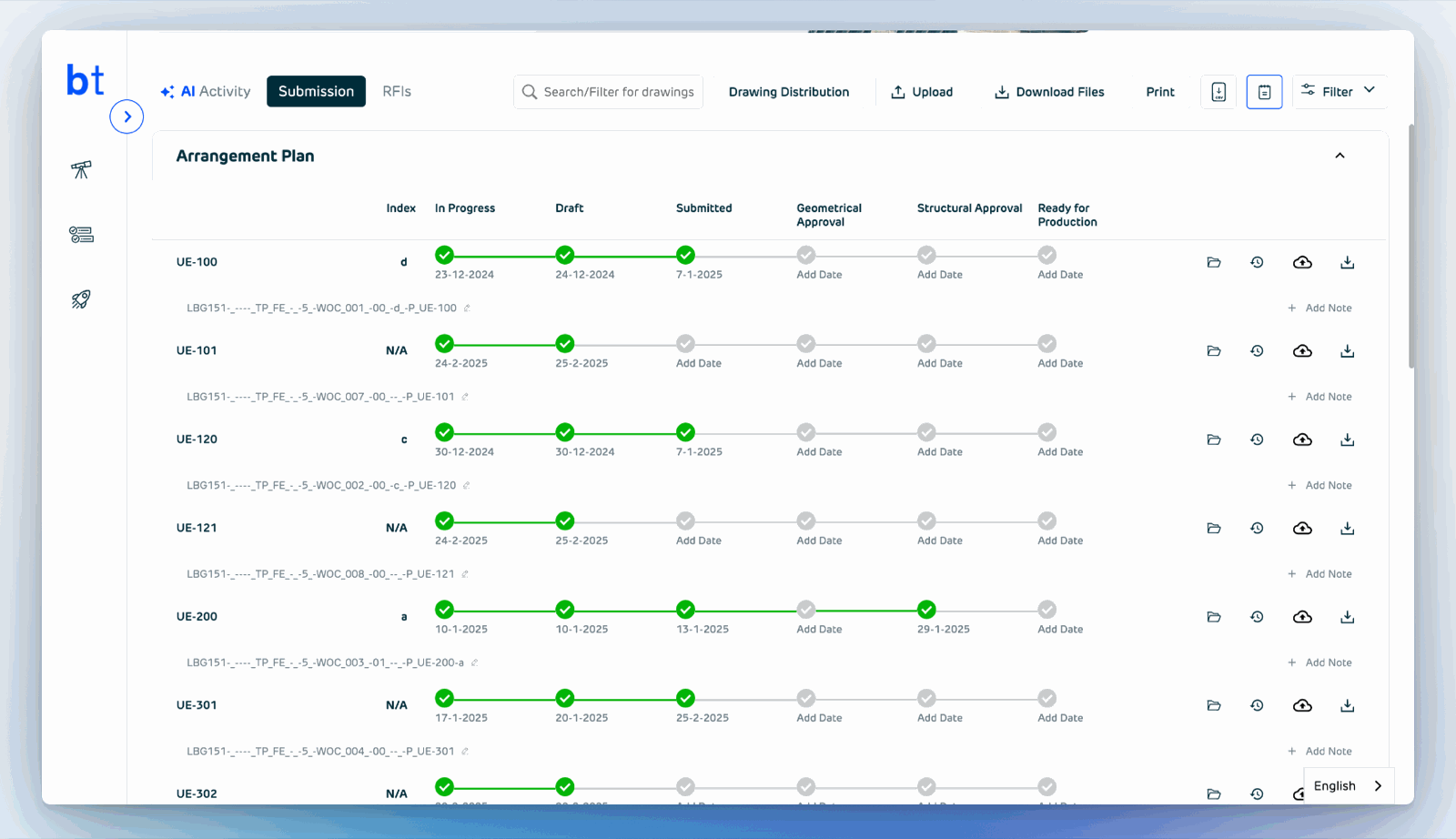
A record that technically exists on the day of a Gateway Three inspection and a record that stays accurate for the following thirty years are not the same achievement, and the Act is written with the second one in mind. "Digital" is a minimum, not the standard: a shared drive full of PDFs is digital and still fails the intent of the duty if nobody can say with confidence which version is current or who changed what and when. A record that can only say "this is the current drawing" is doing half the job; a record that can also say who superseded the previous version, when, and on whose approval, is doing the job the Act actually intends.
What the duty actually asks for is closer to an audit trail than an archive — a record that can answer, at any point in a building's life, exactly what its current safety-critical information is and exactly how it got there. Building that kind of record is a data and modelling discipline as much as a legal compliance exercise, and it is the subject we cover in detail in our companion piece on making the golden thread work in practice — structuring the model, controlling revisions, and handing over something the next owner can actually use.
Getting ready for the duty
The projects that meet this duty comfortably are the ones that treat it as continuous from the start of design, not as a Gateway Three scramble. Confirm early whether a project is in scope. Name the accountable roles on paper before Gateway Two, rather than discovering at Gateway Three that nobody was clearly responsible for a section of the record. And build the record so that handover — from principal contractor to accountable person, or from one accountable person to the next — is an export from a system that has been current throughout, not a reconstruction exercise under deadline pressure.
None of that is complicated to state. It is demanding to sustain over a multi-year project, which is exactly why the Act made it a duty rather than leaving it as advice.