ARTICLE
Precast Concrete Column Cap: Essential Engineering Considerations for Structural Integrity
A column cap looks like a small element on a drawing and behaves like a critical one on site. This is what has to be resolved before it is detailed, and what shows up when it is not.

What a column cap has to do
A column cap sits at the point where a vertical, generally well-behaved compression load in a precast column has to turn into a connection: to a beam, to another column above, or to a transfer structure carrying the loads of everything the column supports. It is a small element carrying a concentrated load path, and concentrated load paths are exactly where reinforced concrete needs the most careful detailing.
Functionally, the cap has three jobs at once. It transfers the vertical load from the column into whatever bears on or through it, without local crushing or splitting of the concrete. It provides a connection — bearing, dowelled, grouted or a proprietary hardware system — capable of resisting whatever horizontal, moment or tension force the structure imposes on it, not just the load case that happens to dominate. And it does all of this within a geometry small enough to cast, handle and erect as part of a column, not as a separate operation.
Getting any one of the three wrong tends to compromise the other two, which is why the column cap is treated as its own detailing problem rather than an afterthought on the column drawing.
Load transfer and reinforcement at the head
Vertical load transfer at a column head is a bearing problem before it is anything else. The bearing area has to be large enough, and the concrete strength high enough, to keep bearing stress within the limits the governing code sets for concentrated loads on a confined or unconfined area — and where the load is transferred through a smaller contact area than the column itself, that concentration has to be checked explicitly rather than assumed to be absorbed by the column's general reinforcement.
Two reinforcement mechanisms do most of the work locally. Bursting reinforcement — closed links or a grid of bars near the head — resists the lateral spreading force that a concentrated vertical load generates as it disperses into the wider section below. Confinement reinforcement, typically closely spaced links, increases the effective strength and ductility of the concrete directly under the bearing area. Both are code-governed, both are sized from the actual bearing geometry and load rather than copied from a similar-looking detail on a different project, and both have to physically fit alongside the column's main reinforcement without a congestion problem that makes the cap difficult to cast cleanly.
Connection types and their trade-offs
The connection at the cap is chosen for structural demand, erection sequence and tolerance, and the choice changes what the detail has to show.
- Simple bearing — the column or beam above sits directly on the cap, sometimes on a bearing pad, transferring vertical load with limited moment or tension capacity. Straightforward to detail and erect; unsuitable where the connection has to resist significant lateral or uplift force.
- Corbels and haunches — a projecting bracket that supports a beam reaction below the top of the column, common where a beam needs to bear without notching into the column. Corbel design follows short-shear-span behaviour, governed by different rules than ordinary flexure, and the reinforcement — primary tension steel anchored properly at the face, plus horizontal stirrups — is specific to that behaviour.
- Grouted sleeve connections — reinforcing bars from the element above are inserted into corrugated sleeves cast into the cap and filled with a high-strength, often expansive, grout, developing continuity close to that of cast-in-place concrete. Strong and relatively compact, at the cost of tight tolerance requirements on bar and sleeve position.
- Dowelled connections — projecting or pocketed dowels aligned between elements, sometimes combined with a bedding of grout or mortar, giving more tolerance for site adjustment than a grouted sleeve, generally at some cost in stiffness or moment capacity.
None of these is universally correct. The right choice depends on the moment, shear and tension the connection has to carry, the erection sequence, and how much positional tolerance the site can realistically hold.
Tolerance, packing and erection stability
A column cap connection is only as good as the tolerance it was detailed to accommodate, because precast elements do not arrive on site at their theoretical position. Casting tolerance, transport and handling, and erection tolerance all stack, and the connection has to absorb that stack without the engineer's assumed bearing or embedment length disappearing.
Packing — shims or purpose-made packers between bearing surfaces — is the usual mechanism for taking up the vertical component of that tolerance, and the detail has to state explicitly what packing material is permitted, its maximum stack thickness, and how it is fixed so it cannot walk out under vibration or repeated load. Horizontal tolerance is generally absorbed at the dowel, sleeve or fixing rather than at the bearing.
Temporary stability during erection is a separate problem from the finished connection's capacity, and it is often under-detailed. A column standing on a cap before the permanent connection is complete, or before the diaphragm that will eventually restrain it is in place, needs a defined temporary bracing or propping arrangement, and that arrangement belongs on the erection drawing, not in the erection crew's judgement on the day.
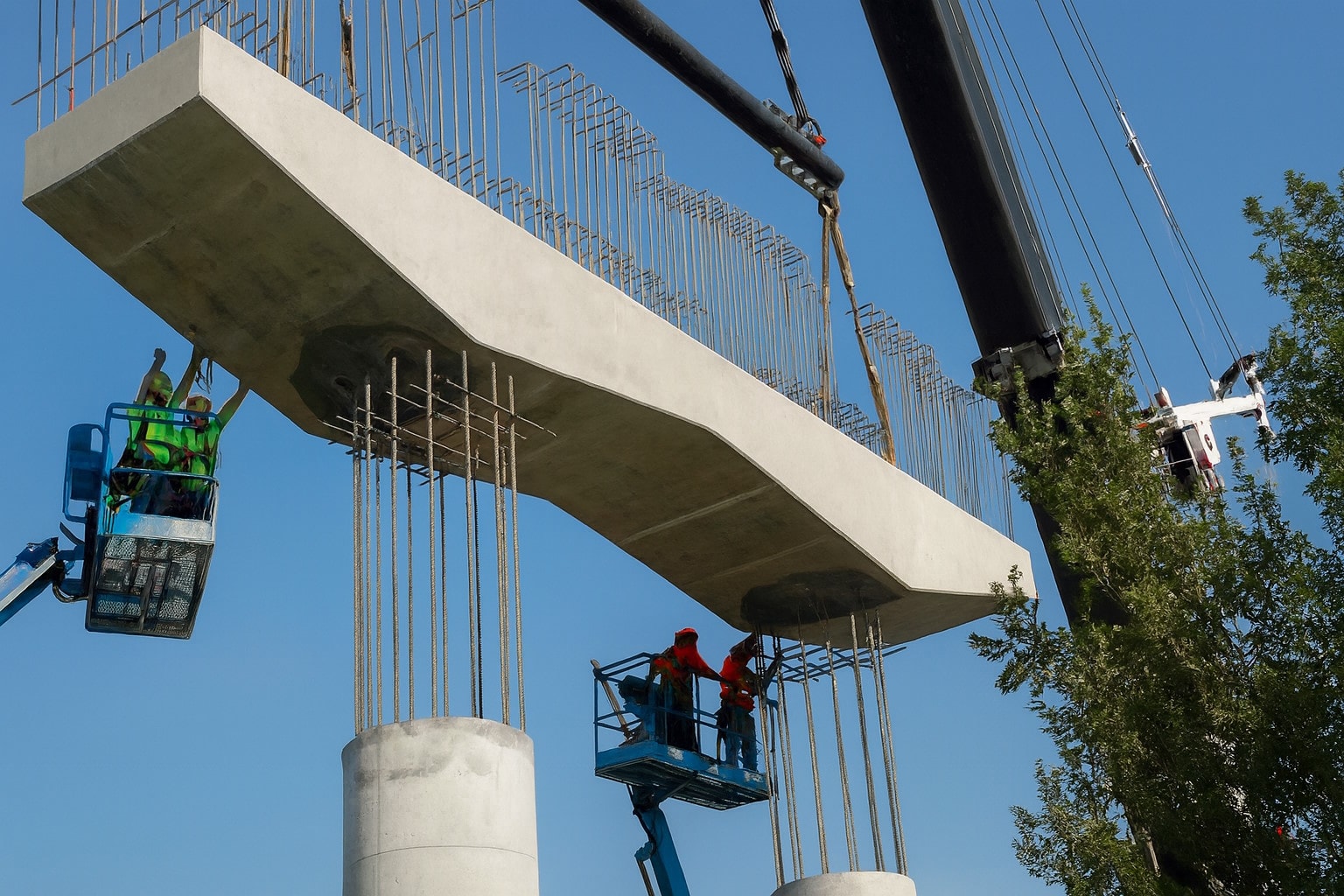
What the drawing has to show
A column cap detail earns its purpose only if what is built matches what was designed, and that depends on the drawing carrying specific information rather than a generic connection callout.
- Bearing geometry — the actual bearing area, material and thickness of any bearing pad, and the assumed bearing length the design relies on.
- Reinforcement — bursting and confinement steel at the head, shown with real dimensions and cover, not referenced to a typical detail that may not match this cap's geometry.
- Connection hardware — sleeve, dowel or proprietary system, with manufacturer reference, embedment length, and installation tolerance stated on the drawing, not left to a data sheet nobody on site has.
- Packing — permitted material, maximum thickness and fixing method.
- Grout specification, where used — product type or performance requirement, minimum strength at stripping and at load, and curing time before load can be applied.
- Temporary stability requirements during erection, referenced to the erection sequence drawing.
Every one of these is a detail that, left out, someone on site will decide for themselves — usually reasonably, occasionally not, and never in a way that is recorded against the design.
Common detailing errors
The errors that recur across column cap details are rarely exotic; they are omissions.
- Bursting reinforcement sized from a similar project rather than the actual bearing geometry and load on this cap.
- Congestion left unresolved — bursting links, confinement steel, sleeve or dowel cages and the column's main bars specified without checking they physically fit and can be cast around.
- Packing left unspecified, so the site improvises a stack of whatever shim is on hand, with no record of what was actually used or whether it meets the design assumption.
- Temporary stability assumed rather than detailed, leaving an erection crew to judge propping requirements without engineering input.
- Grout curing time ignored under programme pressure, with load applied to a connection before the grout has reached the strength the design assumes.
- Fire and durability cover treated as a formality rather than checked against the specific exposure class and fire rating the element needs, particularly where sleeves or hardware reduce the effective cover available.
Each of these is straightforward to catch with a systematic, checklist-driven review of the cap detail against its actual geometry and load. None of them is straightforward to fix once the element has been cast.